Showing posts with label Still sane. Show all posts

Monday, November 24, 2025

🌌 Turbulence Under a Starry Night: Van Gogh’s Vision Between Art and Chaos

Few paintings in human history feel as alive as Vincent van Gogh’s The Starry Night (1889).

It is not just a view — it is a vision, a night sky caught in motion, vibrating with the energy of a restless soul. Painted from his window in the asylum of Saint-RĂ©my-de-Provence, it was his attempt to map the invisible: the motion of the cosmos, and the turbulence within his own mind.

Below is a poem inspired by that moment — one where human anguish met celestial geometry.


“Turbulence Under a Starry Night”

In Saint-Rémy, silence hums like fever,
a sky unfastened, trembling into form.
The window bars divide his world in two—
below, the sleeping village,
above, the whirlpool of infinity.

He paints what the eye cannot still,
what the soul alone can sense—
swirls of cobalt, halos of gasping gold,
each star a heartbeat caught mid-collapse,
each brushstroke a pulse of delirium.

The cypress climbs like a dark flame,
its root in the grave, its crown in the heavens—
a bridge between the living and the gone.
He saw in its tapering silhouette
the whisper that life leans always toward death,
not in fear, but in longing for rest.

The night is not calm—
it breathes, it writhes, it thinks.
Within its vortices lies a strange order,
eddies upon eddies, self-similar chaos—
a painter’s intuition of Kolmogorov’s dream,
decades before the physicist gave it name.
The sky moves in scales of turbulence—
from cosmic to human,
from the galaxy’s spin
to the trembling of a man’s hand.

In his mind, the same storm churned:
a cascade of thoughts,
from grand design to whispering despair.
He felt the air’s friction,
the unseen flow of madness made visible—
and he called it light.

The luminous yellows, electric blues,
were not the world’s colors—
they were his heart's frequencies,
a map of pressure zones and pain,
of currents in the soul
that no science could model.

He was both the painter and the particle,
adrift in the great turbulence—
the cosmos dreaming itself through him.
And when the night ended,
its stars still turned within his eyes,
each one a testament:
that beauty, even when born of torment,
is the calmest form of chaos.


🎹 The Painting: Where Heaven and Earth Swirl Together

Van Gogh painted The Starry Night while confined to the Saint-Paul asylum in 1889, a year before his death.
What he saw from his barred window was a quiet village and a dawn sky.
What he painted was something else entirely — an emotional landscape where motion, color, and longing fuse into one.

The cypress tree in the foreground is key.
In Mediterranean culture, cypress trees were symbols of death, often found in graveyards.
But in Van Gogh’s hands, the cypress is alive, reaching skyward — a bridge between life and eternity, death and transcendence.
It’s as if he is saying: even the dead tree burns with cosmic fire.

The swirling heavens above were not literal — they were emotional and physical manifestations of movement.
Van Gogh wrote to his brother Theo that he sought “a greater meaning than appearances,” and that “the night is more alive and more richly colored than the day.”


đŸ’« The Physics of Turbulence: Kolmogorov and the Cosmic Flow

More than half a century after Van Gogh’s death, the physicist Andrey Kolmogorov (1941) described how turbulence behaves across scales — from large eddies to small — in a phenomenon known as the Kolmogorov cascade.
In turbulent flow, energy transfers from big swirling motions to smaller and smaller ones, creating self-similar patterns — chaotic yet mathematically ordered.

Modern image analyses of The Starry Night (notably by SĂĄnchez et al., 2004, Nature) revealed something astonishing:
Van Gogh’s brushstrokes statistically mimic the energy distribution of real physical turbulence.
The brightness fluctuations in his painted swirls obey Kolmogorov scaling laws, as if his perception — guided by emotion, not mathematics — had seen the hidden laws of the universe.

In that sense, Van Gogh’s “madness” was not a breakdown but an expanded state of perception.
Where others saw stars, he saw motion.
Where others saw light, he saw energy transfer.
His brush became a seismograph of the invisible.


The Inner Storm: Turbulence of Mind and Cosmos

Van Gogh’s letters describe his struggle as one of being “in a storm,” not outside of it.
His mind oscillated between luminous clarity and violent despair — not unlike the vortices he painted.
The turbulence of thought met the turbulence of the cosmos, and the two reflected one another.

In the poem, this is the heart of the metaphor:

“He was both the painter and the particle,
adrift in the great turbulence—
the cosmos dreaming itself through him.”

He was the medium through which the universe painted itself — a vessel where physics and feeling merged.


🌠 Conclusion: Beauty as the Calmest Form of Chaos

The Starry Night endures because it reconciles opposites:
chaos and calm, death and light, madness and meaning.
It embodies what science and spirituality both seek — the pattern in the storm.

And perhaps that is the final truth Van Gogh glimpsed:
that even in the mind’s deepest turbulence,
beauty can emerge —
not as escape,
but as order born from chaos.

Saturday, November 22, 2025

Starry Nights and Celestial Messages: A Journey Through Art and Science

When we gaze at the night sky, we are often filled with awe, wonder, and a desire to understand the universe beyond our reach. Two masterpieces—one of art, one of science—invite us to do exactly that: Vincent van Gogh’s The Starry Night (1889) and Galileo Galilei’s Sidereus Nuncius, known as The Starry Messenger (1610). Though separated by centuries and disciplines, they share a profound connection: a human longing to capture, interpret, and communicate the mysteries of the stars.

The Starry Night: An Emotional Universe on Canvas

Van Gogh’s The Starry Night is arguably one of the most iconic paintings in Western art. Created during his stay at the Saint-Paul-de-Mausole asylum in Saint-RĂ©my-de-Provence, the swirling night sky above the quiet village is both turbulent and serene. Every brushstroke pulsates with emotion—the luminous stars, the glowing crescent moon, and the dark, cypress silhouettes seem to breathe with life.

While many have interpreted the painting as a reflection of van Gogh’s inner turmoil, it is also a celebration of the cosmos. The sky dominates the canvas, suggesting that the universe is vast, mysterious, and alive. Van Gogh once wrote about his desire to “express the terrible passions of humanity,” and in The Starry Night, these passions find a cosmic counterpart in the eternal rhythm of the stars.

The Starry Messenger: Galileo’s Window to the Cosmos

Nearly three centuries earlier, Galileo Galilei changed humanity’s perception of the night sky with Sidereus Nuncius (The Starry Messenger). Published in 1610, it detailed his observations through the newly invented telescope: the rough, mountainous surface of the Moon, countless stars invisible to the naked eye, and moons orbiting Jupiter.

Galileo’s work marked a pivotal moment in the Scientific Revolution. It challenged the long-held Aristotelian view of the heavens as perfect and unchanging. By revealing a universe full of previously unseen wonders, Galileo invited humanity to question, explore, and seek knowledge beyond tradition. His messenger, the stars themselves, spoke of the vastness, complexity, and beauty of the cosmos.

Connecting the Art and the Science

At first glance, van Gogh’s emotional, swirling skies and Galileo’s empirical observations may seem worlds apart. Yet both works are deeply human responses to the same source of wonder: the night sky.

  • Observation and Interpretation: Galileo meticulously recorded what he saw, transforming observation into knowledge. Van Gogh, by contrast, observed with the heart, transforming perception into expression. Both seek to communicate the cosmos to others.

  • Challenging Perceptions: Just as Galileo disrupted the geocentric worldview, van Gogh challenged the artistic norms of his time, infusing nature with personal emotion and dynamic energy.

  • The Universe as a Mirror: In The Starry Night, the stars reflect van Gogh’s inner life; in The Starry Messenger, the stars reflect the hidden structure of the universe. Both works remind us that looking outward often illuminates what lies within.

A Shared Human Impulse

Ultimately, both the painting and the book capture humanity’s enduring fascination with the heavens. Whether through the brush or the telescope, we seek to make sense of the night sky, to interpret it, and to convey its mysteries. The Starry Night and The Starry Messenger are testaments to the universal human impulse: to gaze upward, to wonder, and to communicate that wonder to the world.

So, the next time you look at a starry night, remember that you are part of a continuum—a lineage of dreamers and thinkers, from Galileo peering through his telescope to van Gogh painting the cosmos with his heart. The stars have always been, and will always remain, a bridge between curiosity and imagination.

Sunday, November 16, 2025

A Legacy Brewed in Simplicity: The Indian Coffee House at IISER Bhopal

In the quiet heart of the Indian Institute of Science Education and Research (IISER) campus in Bhopal, one finds a familiar red-and-white board carrying a name that resonates across India’s academic, cultural, and political landscapes — Indian Coffee House.

This isn’t just a cafeteria; it’s part of a national cooperative movement that has sustained India’s intellectual and social pulse since the mid-20th century. Run by the Indian Coffee Workers’ Cooperative Society (I.C.W.C.S.) Ltd., Jabalpur, and affiliated to the All India Coffee Workers’ Cooperative Society Federation Ltd., Delhi, this branch continues a legacy dating back to 1958 — a year proudly printed at the top of its menu board.

Below, the menu itself becomes a historical document — a testament to continuity, adaptation, and democratic hospitality.


THE MENU: A COMPLETE TRANSCRIPTION

(From the menu board at IISER Bhopal Campus)


INDIAN Coffee HOUSE

RUN BY I.C.W.C.S. LTD., JABALPUR, AFFILIATED TO A.I.C.W.C.S. FEDERATION LTD., DELHI
ESTD. 1958   REGD NO. 1485   GSTIN: 23AAA TI0884Q1ZA


BEVERAGES

Hot Coffee
Tea
Horlicks
Milk
Ice Coffee
Cold Coffee
Cold Coffee with Ice Cream
Lemon Tea
Lemon Soda
Lime Water
Lime Soda


ICE CREAMS

Ice Cream Pineapple
Ice Cream Strawberry
Ice Cream Vanilla
Ice Cream Chocolate
Ice Cream Butter Scotch
Ice Cream Kesar Pista
Ice Cream Nut Fruit


SANDWICHES

Vegetable Sandwiches
Jam Sandwiches
Egg Sandwiches
Chicken Sandwiches


GRILLED SANDWICHES

Grilled Veg Sandwich
Grilled Egg Sandwich
Grilled Chicken Sandwich
Cheese Sandwich
Cheese Egg Sandwich
Cheese Chicken Sandwich


SOUP

Tomato Soup
Veg Soup
Mushroom Soup
Sweet Corn Veg Soup
Sweet Corn Chicken Soup
Hot & Sour Veg Soup
Hot & Sour Chicken Soup
Chicken Noodle Soup
Chicken Clear Soup


SNACKS

Masala Dosa
Sada Dosa
Onion Dosa
Butter Dosa
Paneer Masala Dosa
Cheese Masala Dosa
Mysore Masala Dosa
Paper Dosa
Cheese Paper Dosa
Idly (2 Piece)
Vada (2 Piece)
Idly Vada (2 + 1 Piece)
Onion Uthappa
Plain Uthappa
Tomato Uthappa
Veg Cutlet (1 Piece)
Egg Cutlet (1 Piece)
Fish Cutlet (1 Piece)
Egg Omelette
Bread Omelette
Veg Burger
Paneer Burger
Cheese Burger
Chicken Burger
Veg Roll
Egg Roll
Chicken Roll
Samosa (2 Piece)
Pav Bhaji
Veg Puff
Egg Puff
Chicken Puff
Veg Patties
Egg Patties
Chicken Patties
Veg Bonda
Veg Pakoda
Onion Pakoda
Veg Chop
Dal Vada (2 Piece)
Tomato Bhajji
Mirchi Bhajji
Bread Pakoda
Bread Toast (Plain)
Bread Butter Toast
Cheese Toast
Cheese Chilly Toast
Veg Cutlet (2 Piece)
Egg Cutlet (2 Piece)
Fish Cutlet (2 Piece)


RICE, PULAO & BIRYANI

Rice Plain
Rice Fried
Jeera Rice
Curd Rice
Veg Pulao
Peas Pulao
Veg Fried Rice
Paneer Fried Rice
Egg Fried Rice
Chicken Fried Rice
Mutton Fried Rice
Veg Biryani
Paneer Biryani
Egg Biryani
Chicken Biryani
Mutton Biryani


EGGS

Boiled Egg (2 Piece)
Half Fry
Egg Curry
Egg Masala Curry
Egg Mughlai


THALI

Mini Thali
Veg Thali
South Indian Thali
Special Thali
Chitra Thali


MEALS: INDIAN VEG

Roti
Roti Butter
Paneer Butter Masala
Paneer Kadai
Paneer Do Pyaza
Shahi Paneer
Mutter Paneer
Palak Paneer
Paneer Bhurji
Paneer Kofta
Veg Kofta
Aloo Dum
Aloo Gobhi
Aloo Matar
Aloo Palak
Veg Curry
Veg Butter Masala
Veg Kadai
Veg Do Pyaza
Veg Bhurji
Mixed Vegetable
Bhindi Fry
Bhindi Masala
Chana Masala
Dal Fry
Dal Tadka
Dal Makhani


MUTTON

Mutton Curry
Mutton Do Pyaza
Mutton Korma
Mutton Masala
Mutton Rogan Josh
Mutton Bhuna
Mutton Kadai
Mutton Mughlai
Mutton Butter Masala


CHICKEN

Chicken Curry
Chicken Masala
Chicken Do Pyaza
Chicken Korma
Chicken Rogan Josh
Chicken Bhuna
Chicken Kadai
Chicken Mughlai
Chicken Butter Masala


CHINESE NON-VEG

Egg Fried Rice
Egg Chowmein
Chicken Fried Rice
Chicken Chowmein
Chicken Noodles
Chicken Chilly
Chicken Garlic
Chicken Manchurian
Chicken Hot & Sour Soup
Chicken Mushroom Soup
Chicken Sweet Corn Soup


KERALA SPECIAL BIRYANI

Kerala Special Chicken Biryani
Kerala Special Mutton Biryani


ICE CREAM (Top N Town)

Vanilla Cup
Strawberry Cup
Pineapple Cup
Choco Bar
Kesar Pista
Magic Cone


📍 IISER CAMPUS, BHOPAL (M.P.)


A COOPERATIVE TRADITION BREWED IN HISTORY

The Indian Coffee House chain has an origin unlike any modern cafĂ©. Its roots lie in postcolonial labor movements and the collapse of the British-run Coffee Board cafeterias in the 1950s. When these were slated for closure, the workers formed cooperatives — first in Bangalore and later in other cities — reclaiming the establishments as worker-owned cafĂ©s.

Each branch is run by a regional cooperative, such as the Indian Coffee Workers Cooperative Society (I.C.W.C.S.) Ltd., Jabalpur, responsible for the Madhya Pradesh units, including the one at IISER Bhopal. These cooperatives are federated under the A.I.C.W.C.S. Federation Ltd., Delhi, maintaining shared heritage but independent operation.

This cooperative structure means:

  • The workers own and manage the establishment collectively.

  • Profits are shared rather than extracted.

  • The dĂ©cor and menu are standardized and affordable, reflecting continuity rather than branding.


READING BETWEEN THE LINES: WHAT THE MENU TELLS US

A close reading of the menu reveals several fascinating layers:

  1. Inclusivity Across Diets:
    The menu spans vegetarian, egg, chicken, and mutton options, but without alcohol or pork — consistent with the chain’s secular and inclusive ethos catering to students, office-goers, and families alike.

  2. Pan-Indian Palette:
    From Dosa, Idly, and Vada to Roti, Paneer Butter Masala, and Biryani, the offerings blend South Indian café culture with North Indian meals, echoing the linguistic and culinary diversity of post-independence India.

  3. Affordable Homeliness:
    The repetition of items like Cutlets, Thalis, and Butter Coffee evokes an era of simple, filling meals — not fine dining but sustenance with care.

  4. Echoes of the Socialist Past:
    The absence of brand-heavy items (beyond “Top N Town” ice creams) speaks to an anti-corporate ethos, where the cafĂ©’s value lies in accessibility and equality rather than profit margins.

  5. Student-Centric Comfort:
    Located within the IISER Bhopal campus, this branch functions as a social commons — a space for affordable meals, long discussions, and solitude alike. In a scientific campus setting, its analog warmth contrasts beautifully with the high-tech environment.


THE INDIAN COFFEE HOUSE EXPERIENCE

Unlike global cafĂ© chains, Indian Coffee Houses are unpretentious. The white-uniformed waiters with red turbans, the metallic tumblers of coffee, and the faded menus together create an atmosphere of continuity — a place where generations of students, activists, and thinkers have gathered.

At IISER Bhopal, this continuity persists. The menu shows no fusion gimmicks, no “signature lattes” or “gourmet wraps.” Instead, it offers ritual familiarity: Masala Dosa, Cutlet, Coffee.
It’s not nostalgia — it’s living heritage.


CONCLUSION: MORE THAN A CAFÉ, A MOVEMENT

The Indian Coffee House at IISER Bhopal isn’t just a place to eat. It’s a microcosm of cooperative India — an enduring symbol of worker dignity, inclusivity, and timeless hospitality.

In an era where global coffee brands define status and identity, this humble establishment reminds us that good coffee, shared conversation, and collective ownership remain powerful, revolutionary ideas.


Sunday, October 26, 2025

The Beautiful Struggle of the Ones Who Never Quite Catch Up

There’s a certain kind of person we all know — maybe even see in the mirror — who is always almost there. They’re the ones who are constantly trying to catch up: to a goal, a version of themselves, a success they can almost taste but never quite reach. They stay up late fine-tuning details, run a little faster, push a little harder, but somehow, the finish line keeps moving just as they’re about to cross it.

It’s not that they’re lazy or lack talent — far from it. They’re often the most driven, the ones with notebooks full of plans, sticky notes of motivation, and browser tabs brimming with “how to improve” articles. But life, as it tends to do, shifts the goalpost. Just as they master one skill, the standard rises. Just as they earn one milestone, a new benchmark appears on the horizon.

The cruel irony? The world doesn’t slow down for them to catch up.

The Self-Propagating Cycle of “Almost There”

This cycle feeds itself. The harder you chase, the faster the target moves. The more you learn, the more you realize what you don’t know. Each victory, rather than bringing peace, ignites a new hunger. The chase becomes an identity — a self-sustaining loop where being “behind” feels normal, even necessary.

Over time, the act of catching up becomes less about reaching something tangible and more about staying in motion. The goal is no longer the goal — the pursuit is.

And yet, this endless race doesn’t necessarily breed despair. In fact, many of these perpetual chasers are surprisingly happy.

The Paradox of Contented Striving

How?

Because happiness, for them, doesn’t come from arrival — it comes from movement. The struggle itself gives life rhythm. The small daily wins — shaving a second off a run, solving a tougher problem, finishing a messy project — are enough to create moments of satisfaction.

They’ve subconsciously reframed success: it’s not the perfect ending, but the fact that they’re still in the story.

There’s something quietly noble about that — to know you’ll never quite “catch up,” and yet to keep showing up. To still chase improvement in a world that never pauses. To find joy not in triumph, but in persistence.

The Moving Target as a Mirror

Maybe the target was never really meant to be caught. Maybe it exists to keep us moving forward — not because we’ll ever reach it, but because in chasing it, we grow into someone who could have.

Every missed mark is a reminder of our own aliveness — the gap between where we are and where we want to be is what keeps us human. It’s the distance that gives life its tension, its music.

And maybe that’s why those who always fall short can still smile. Because they’ve realized something profound:

That catching up isn’t the point.
Chasing is.

Friday, June 20, 2025

Truth Under Siege: Why Salim Abdool Karim's Faraday Lecture Matters Now More Than Ever

In a world increasingly dominated by misinformation and institutional distrust, Professor Salim Abdool Karim’s 2024 Faraday Prize Lecture lands with the force of a thunderclap. Entitled “Science Under Threat: The Rise of Institutionalized Disinformation,” his address is not just a sobering assessment of our present — it is a call to action for the future of science, democracy, and truth itself.

The Virus of Disinformation

Karim, a globally respected epidemiologist and HIV/AIDS researcher, begins by recounting a disturbing lie: that the HIV virus was manufactured by U.S. scientists and spread via polio vaccines in Africa. This conspiracy theory, once fringe, found foothold thanks to politically motivated disinformation campaigns — notably one orchestrated by the KGB.

This is not just history. It's a template.

Karim traces how the deliberate spread of falsehoods — from HIV/AIDS to COVID-19 and beyond — has been weaponized by states, corporations, and individuals. In particular, he lays bare how Donald Trump's presidency transformed the U.S. government from a source of truth into a megaphone for unverified, often dangerous, claims. From bleach as a COVID cure to downplaying climate change, Karim highlights how institutional trust erodes when leaders themselves become super-spreaders of lies.

State Capture: A Global Pandemic

Perhaps the lecture’s most chilling insight is the notion of “state capture.” Using South Africa under Jacob Zuma as a case study, Karim details how leaders seize not just power, but the very machinery meant to hold them accountable — courts, media, law enforcement, and science agencies. Then he draws an alarming parallel: the U.S., he suggests, is on a similar path under Trump 2.0, complete with a dismantled Department of Justice, co-opted media, and gutted scientific agencies like NIH and the FDA.

Science as the Final Front

Karim argues that science is not just collateral damage in this war on truth — it's a primary target. Scientists are being silenced, data suppressed, and grants cancelled (especially those related to climate change, LGBTQ health, and infectious diseases). The consequences are global. Karim himself reports that his own HIV research unit in South Africa lost half its funding due to U.S. cuts.

And yet, amid the bleakness, he offers hope.

Karim calls on scientists to embrace a new, more public role: as truth sayers. When governments mislead, scientists must become society’s trusted navigators — clearly communicating evidence, rebuilding public trust, and pushing back against narrative manipulation. “Every small act of resistance matters,” he says, likening the fight for truth to the struggle against apartheid, which once also seemed insurmountable.

A Lecture for Our Times

More than a lecture, this was a manifesto. A reminder that the future of democracy, health, and planetary survival hinges on our collective capacity to defend facts. In an age where “experts” emerge from the universities of WhatsApp and Facebook, the real experts — scientists, doctors, journalists — must rise louder and more boldly than ever.

Karim’s words are urgent, necessary, and clear: if we don't stand up for science now, there may soon be nothing left to stand on.

Listen to the full lecture here: 


The Faraday Prize Lecture is an annual event organized by the Royal Society to honor the recipient of the Michael Faraday Prize and Lecture, awarded for excellence in communicating science to UK audiences. Named after the legendary scientist and communicator Michael Faraday, the prize celebrates individuals who have made significant contributions to public engagement with science through writing, speaking, or broadcasting. The lecture provides an opportunity for the awardee to share their insights on science’s role in society, bridging complex scientific ideas with accessible, compelling narratives. In 2024, the prize was awarded to Professor Salim Abdool Karim, whose lecture tackled the urgent and global issue of institutionalized disinformation and its threat to science, democracy, and public trust.

Sunday, July 17, 2022

Dhyān Yog: The Yog of Meditation also known as the Atma-Samyama Yoga

Chapter 6: With 47 verses or shlokas, the sixth chapter is of the same length as the first chapter. 

Arjuna (Shloka 33-34, 37-39): 5 shlokas

Krishna, the Supreme Personality of Godhead (Shloka 1-32, 35-36, 40-47): 42 shlokas

Brief Summary: In this chapter, the lord explains the Dhyan Yog aspect as a continuation of his answer to prince Arjuna in the previous chapter.

Sanyāsīs=yogis=who perform prescribed duties without desiring the results of their actions, is free from feelings of possessiveness, lives in seclusion, and engage the body, mind, and self in a relationship with the supreme.

Shloka 5-6: The mind can be your friend if you have conquered it, but it can also be your worst enemy if you have failed to conquer your mind. 

Free from Dualities: Cold and heat, Joy and sorrow, honor and dishonor, happiness and distress

For the satisfied yogi who is in KC, 

  • Shloka 8: Dirt=stones=gold
  • Shloka 9: Well-wishers=friends=foe=pious=sinners=affectionate=benefactors=envious=neutral =mediators. Notably, this shloka lacks a purport. 
Shloka 11-12 are very specific in detail regarding the pre-requisites for meditation. The specifics are:
  1. Should be performed in a sacred/secluded place. A list of sacred places is mentioned in the purport and includes Prayag, Mathura, Brindavan, Rishikesh, and Haridwar.
  2. Kusha/Kusa grass (Desmostachya bipinnata) should be covered with deerskin and a soft cloth to prepare a seat.
  3. The seat should be at optimum height, i.e., neither too high nor too low.

Shloka 13-14: The sitting position requires the alignment of the body, neck, and head in a straight line. One should focus on the tip of the nose and meditate upon the divine within the heart.

Yoga is not a mere physical exercise, rather it is a means to attain the abode of the lord (AOL). The importance of proper sleep and a healthy diet are explained concerning becoming a perfect yogi. Discipline in the lifestyle can mitigate all material pains, one has to follow the correct schedule for habits of eating, sleeping, recreation, and work in day-to-day life.

The flickering nature of the mind can be controlled by the practice of yoga which can lead to the attainment of trance or "samadhi.". In the stage of samadhi, the person is engrossed in self and attains the highest form of happiness, and is unaffected by the miseries of the material world. 

Arjuna questions the knowledge imparted by Lord Krishna regarding yoga as impractical and unendurable. Characters of the mind described by the prince Arjuna:
  • Restless
  • Turbulent
  • Strong
  • Obstinate
  • More difficult to control than the wind
Lord: practice & detachment. Possible for those who have learned to control the mind.

Arjuna further enquires what happens to the unsuccessful yogi who cannot reach his goal due to an unsteady mind. Would such a person miss out on both material enjoyment and spiritual success? 

The lord reassures Arjuna as follows:
  • Those who strive for KC are never overcome by evil.
  • Unsuccessful yogi attains the abode of the virtuous (AOV) upon death. After dwelling in AOV for many ages, such a yogi is reborn in the family of pious and prosperous people.
  • Else, if a yogi has developed dispassion through long practice of yoga, such a yogi is reborn in the family endowed with divine wisdom.
  • Following rebirth, the yogi strives for liberation with even greater earnestness by reawakening the wisdom of past lives. 

Shloka 46: yogi > tapasvÄ« (ascetic) ; yogi > jñānÄ« (a person of learning); yogi > karmÄ« (ritualistic performer)

The results of spiritual practices are accumulated and passed to the next birth. Hence, even the unsuccessful yogi is making progress and eventually attains liberation. In the last shloka, lord Krishna highlighted the importance of surrendering oneself to the divine with utmost faith and love becoming the highest yogi.

Favorite Shlokas:

Shloka 5:

uddhared ātmanātmānaáč nātmānam avasādayet

ātmaiva hyātmano bandhur ātmaiva ripur ātmanaង

Shloka 16:

nātyaƛhnatastu yogo ’sti na chaikāntam anaƛhnataáž„

na chāti-svapna-ƛhÄ«lasya jāgrato naiva chārjuna


Saturday, April 30, 2022

Escape from MAC's TCP

Understanding the mysteries of birth and death is a complicated affair that has preoccupied mankind from time immemorial. Escaping from the miseries inherent in the cycle of birth and death has been propounded as the ultimate goal of life in eastern religions. Nirvana or liberation from the "beginningless cycle of repeated birth, mundane existence, and dying again" is something that countless spiritual seekers aspire to attain. Attaining liberation requires the utmost faith and effort and is never available to those who doubt everything. In fact, the Bhagavat Gita goes so far as to say, "sanƛhayātmā vinaƛhyati." in chapter-4.40. Hence, the doubting soul has happiness neither in this world nor in the next.

Yet, one can have a doubting soul that fails to understand this sublime transcendental knowledge. Escaping from something simpler may be possible for such doomed souls. A recent pre-print by Sharma et al. focuses on the escape from the MAC (Membrane Attack Complex) encoded by the TCP (Terminal Complement Pathway). In their manuscript titled "Birth and Death in Terminal Complement Pathway," Sharma et al. investigate the emergence of the terminal component pathway in early vertebrates using sequence similarity analysis, comparison of exon length, phase, and domain order. Starting with "Four possible scenarios for the birth of the terminal complement pathway (TCP)," the authors evaluate each scenario against available data to find the most supported aspects. As part of their investigation, the "Status of terminal complement pathway (TCP) components" is identified in representative species from various vertebrate clades. Their research discovered that the complement C9 gene has been duplicated in several species of the order Squamata and potentially degraded in Galliform birds.

The complement C9 of chicken and other Galliform birds has escaped MAC's TCP. Death does not mean liberation. So how do we know that C9 is liberated and not simply dead? Sharma et al. find that the chicken repeat 1 (CR1) element is inserted at the C9 locus in the intronic regions and in the middle of exons. The presence of CR1 elements within the exons disrupts the coding frame and will continue to do so until it is removed. Hence, the re-birth of the C9 gene would require a careful excision of the CR1 elements to reestablish the reading frame. Based on the relatively special type of gene death seen in C9, one could argue a scenario of liberation. But how permanent is liberation? Can a liberated soul be again condemned to a cycle of birth and death? 

Does the soul merge with god after liberation, or does it just become part of a cosmic soul distinct from god? Liberation is even more challenging to understand than birth and death as it remains a primarily theoretical concept for us mere mortals. Nonetheless, C9 is dead; long live the TCP!

Tuesday, July 27, 2021

Chop, crop and search with a custom cutoff criteria

We have been investigating the presence of putative image duplicates in the paper Sharma et al., 2020 using AI based methods that we evaluated using the established examples from Bik et al., 2016 paper. Despite an exhaustive search of all the supplementary figures, we have not been able to find any exact duplicates in this paper. However, it is possible that parts of the figures are chopped, cropped and pasted in different combinations. This would be similar to cutting out the lanes of a gel image and pasting them together into a new image. As we saw in the previous post, the imagededup package does not perform well when faced with duplication with repositioning (category II).

Today, we try to find a simple solution to this problem by chopping up each image into many small pieces and searching them for presence of putative duplicates. The linux utility "convert" is a very powerful tool with many image manipulation abilities. We use the below code snippet to chop each of the images into five almost equally sized parts with vertical lines.

 for img in `ls -1 *`  
 do  
 echo $img  
 convert $img -crop 5x1@ +repage +adjoin "$img"_%d.png  
 mv "$img"_*.png crop1  
 done  

Each of the images now have 5 parts with filenames that mention the old image id and the part number. For instance, image98.png is cut into five parts named as image98.png_0.png, image98.png_1.png, image98.png_2.png, image98.png_3.png and image98.png_4.png. The for loop in the above code does this chopping for each image and moves the chopped files into the crop1 folder. After the images have been chopped using the crop option in convert utility, we can use the imagededup package to look for putative duplicates.

Approximately 300 images are present in the original dataset obtained from Sharma et al., 2020. After chopping each image into five parts, we have 1500 images to deal with. Manually parsing the output of imagededup for high similarity scores is laborious and best avoided. The code given below detects putative image duplicates among the files located in the image_dir folder and stores the results in the duplicates_cnn dictionary. The first for loop in this case iterates through the keys of this dictionary. The second for loop iterates through the values that are stored for each of these keys. Each value is actually a tuple with the first element being the image file name and the second element being the score. We look for scores greater than the cutoff value defined before the for loop and print the key and keyvalue.

 #Find duplicates using CNN along with scores   
 from imagededup.methods import CNN   
 cnn_encoder = CNN()   
 duplicates_cnn = cnn_encoder.find_duplicates(image_dir=image_dir, scores=True)   
 #arbitrary cutoff score  
 cutoff=0.97  
 for key in duplicates_cnn:  
      for keyvals in duplicates_cnn[key]:  
           if keyvals[1] > cutoff:  
                print(key,keyvals)  

The code above will provide us a shorter version of the output listing only the images that are detected to be putative duplicates with very high scores.Even with a high cutoff score of 0.97, we find more than 200 putative duplicates.

 image100.png_4.png ('image93.png_4.png', 0.9714619)  
 image102.png_0.png ('image103.png_0.png', 0.98250186)  
 image103.png_0.png ('image102.png_0.png', 0.98250186)  
 image11.png_0.png ('image12.png_0.png', 0.9850818)  
 image11.png_0.png ('image14.png_0.png', 0.97351915)  
 image11.png_0.png ('image16.png_0.png', 0.9819039)  
 image11.png_0.png ('image20.png_0.png', 0.9708375)  
 image11.png_0.png ('image7.png_0.png', 0.98577213)  
 image114.png_0.png ('image115.png_0.png', 0.9871844)  
 image114.png_0.png ('image116.png_0.png', 0.977131)  
 image115.png_0.png ('image114.png_0.png', 0.9871844)  
 image115.png_0.png ('image116.png_0.png', 0.982214)  
 image115.png_2.png ('image115.png_3.png', 0.97350514)  
 image115.png_3.png ('image115.png_2.png', 0.97350514)  
 image116.png_0.png ('image114.png_0.png', 0.977131)  
 image116.png_0.png ('image115.png_0.png', 0.982214)  
 image118.png_0.png ('image120.png_0.png', 0.988398)  
 image118.png_0.png ('image121.png_0.png', 0.9891088)  
 image12.png_0.png ('image11.png_0.png', 0.9850818)  
 image12.png_0.png ('image14.png_0.png', 0.97201216)  
 image12.png_0.png ('image16.png_0.png', 0.98974717)  
 image12.png_0.png ('image20.png_0.png', 0.9705702)  
 image12.png_0.png ('image7.png_0.png', 0.9938463)  
 image120.png_0.png ('image118.png_0.png', 0.988398)  
 image120.png_0.png ('image121.png_0.png', 0.9912125)  
 image121.png_0.png ('image118.png_0.png', 0.9891088)  
 image121.png_0.png ('image120.png_0.png', 0.9912125)  
 image122.png_0.png ('image123.png_0.png', 0.98453903)  
 image122.png_0.png ('image124.png_0.png', 0.99413013)  
 image123.png_0.png ('image122.png_0.png', 0.98453903)  
 image123.png_0.png ('image124.png_0.png', 0.98252416)  
 image124.png_0.png ('image122.png_0.png', 0.99413013)  
 image124.png_0.png ('image123.png_0.png', 0.98252416)  
 image124.png_2.png ('image124.png_3.png', 0.9753659)  
 image124.png_3.png ('image124.png_2.png', 0.9753659)  
 image13.png_3.png ('image13.png_4.png', 0.99999994)  
 image13.png_4.png ('image13.png_3.png', 0.99999994)  
 image138.png_0.png ('image139.png_0.png', 0.9742407)  
 image139.png_0.png ('image138.png_0.png', 0.9742407)  
 image139.png_0.png ('image141.png_0.png', 0.9892728)  
 image139.png_0.png ('image174.png_0.png', 0.97267145)  
 image14.png_0.png ('image11.png_0.png', 0.97351915)  
 image14.png_0.png ('image12.png_0.png', 0.97201216)  
 image14.png_0.png ('image16.png_0.png', 0.98304456)  
 image14.png_0.png ('image20.png_0.png', 0.9994699)  
 image14.png_0.png ('image7.png_0.png', 0.9742934)  
 image141.png_0.png ('image139.png_0.png', 0.9892728)  
 image141.png_0.png ('image174.png_0.png', 0.9725107)  
 image141.png_1.png ('image141.png_2.png', 0.97022605)  
 image141.png_2.png ('image141.png_1.png', 0.97022605)  
 image142.png_0.png ('image144.png_0.png', 0.986072)  
 image143.png_0.png ('image145.png_0.png', 0.9743204)  
 image144.png_0.png ('image142.png_0.png', 0.986072)  
 image145.png_0.png ('image143.png_0.png', 0.9743204)  
 image15.png_4.png ('image18.png_4.png', 0.9827007)  
 image151.png_0.png ('image154.png_0.png', 0.97797024)  
 image152.png_0.png ('image153.png_0.png', 0.9902647)  
 image153.png_0.png ('image152.png_0.png', 0.9902647)  
 image153.png_0.png ('image154.png_0.png', 0.97013867)  
 image154.png_0.png ('image151.png_0.png', 0.97797024)  
 image154.png_0.png ('image153.png_0.png', 0.97013867)  
 image156.png_0.png ('image158.png_0.png', 0.97740877)  
 image158.png_0.png ('image156.png_0.png', 0.97740877)  
 image159.png_0.png ('image160.png_0.png', 0.9743622)  
 image159.png_0.png ('image161.png_0.png', 0.9805405)  
 image159.png_1.png ('image159.png_3.png', 0.9810934)  
 image159.png_3.png ('image159.png_1.png', 0.9810934)  
 image16.png_0.png ('image11.png_0.png', 0.9819039)  
 image16.png_0.png ('image12.png_0.png', 0.98974717)  
 image16.png_0.png ('image14.png_0.png', 0.98304456)  
 image16.png_0.png ('image20.png_0.png', 0.98187333)  
 image16.png_0.png ('image7.png_0.png', 0.9959326)  
 image160.png_0.png ('image159.png_0.png', 0.9743622)  
 image161.png_0.png ('image159.png_0.png', 0.9805405)  
 image164.jpg_0.png ('image287.jpg_0.png', 0.9828615)  
 image168.png_0.png ('image169.png_0.png', 0.9929953)  
 image169.png_0.png ('image168.png_0.png', 0.9929953)  
 image174.png_0.png ('image139.png_0.png', 0.97267145)  
 image174.png_0.png ('image141.png_0.png', 0.9725107)  
 image178.png_0.png ('image179.png_0.png', 0.9757037)  
 image179.png_0.png ('image178.png_0.png', 0.9757037)  
 image18.png_4.png ('image15.png_4.png', 0.9827007)  
 image182.png_0.png ('image183.png_0.png', 0.98172903)  
 image183.png_0.png ('image182.png_0.png', 0.98172903)  
 image188.png_0.png ('image189.png_0.png', 0.98023623)  
 image189.png_0.png ('image188.png_0.png', 0.98023623)  
 image192.png_0.png ('image194.png_0.png', 0.9978157)  
 image194.png_0.png ('image192.png_0.png', 0.9978157)  
 image20.png_0.png ('image11.png_0.png', 0.9708375)  
 image20.png_0.png ('image12.png_0.png', 0.9705702)  
 image20.png_0.png ('image14.png_0.png', 0.9994699)  
 image20.png_0.png ('image16.png_0.png', 0.98187333)  
 image20.png_0.png ('image7.png_0.png', 0.9730121)  
 image202.png_0.png ('image203.png_0.png', 0.9940014)  
 image203.png_0.png ('image202.png_0.png', 0.9940014)  
 image211.png_0.png ('image212.png_0.png', 0.98358434)  
 image212.png_0.png ('image211.png_0.png', 0.98358434)  
 image212.png_0.png ('image214.png_0.png', 0.9713317)  
 image214.png_0.png ('image212.png_0.png', 0.9713317)  
 image215.jpeg_0.png ('image215.jpeg_1.png', 0.9919382)  
 image215.jpeg_1.png ('image215.jpeg_0.png', 0.9919382)  
 image219.png_2.png ('image219.png_3.png', 0.97034454)  
 image219.png_3.png ('image219.png_2.png', 0.97034454)  
 image220.png_0.png ('image221.png_0.png', 0.9760274)  
 image221.png_0.png ('image220.png_0.png', 0.9760274)  
 image221.png_2.png ('image221.png_3.png', 0.97269195)  
 image221.png_3.png ('image221.png_2.png', 0.97269195)  
 image23.png_0.png ('image25.png_0.png', 0.97705656)  
 image23.png_2.png ('image26.png_2.png', 0.97086954)  
 image234.png_0.png ('image235.png_0.png', 0.99267024)  
 image234.png_1.png ('image234.png_2.png', 0.97507715)  
 image234.png_2.png ('image234.png_1.png', 0.97507715)  
 image235.png_0.png ('image234.png_0.png', 0.99267024)  
 image237.png_0.png ('image238.png_0.png', 0.9760754)  
 image238.png_0.png ('image237.png_0.png', 0.9760754)  
 image238.png_0.png ('image239.png_0.png', 0.9754666)  
 image239.png_0.png ('image238.png_0.png', 0.9754666)  
 image242.png_0.png ('image243.png_0.png', 0.9714698)  
 image243.png_0.png ('image242.png_0.png', 0.9714698)  
 image245.png_0.png ('image246.png_0.png', 0.97148263)  
 image245.png_0.png ('image247.png_0.png', 0.97165793)  
 image246.png_0.png ('image245.png_0.png', 0.97148263)  
 image246.png_0.png ('image247.png_0.png', 0.9809675)  
 image247.png_0.png ('image245.png_0.png', 0.97165793)  
 image247.png_0.png ('image246.png_0.png', 0.9809675)  
 image25.png_0.png ('image23.png_0.png', 0.97705656)  
 image257.png_0.png ('image258.png_0.png', 0.98425305)  
 image257.png_0.png ('image259.png_0.png', 0.9732449)  
 image258.png_0.png ('image257.png_0.png', 0.98425305)  
 image258.png_0.png ('image259.png_0.png', 0.98271394)  
 image259.png_0.png ('image257.png_0.png', 0.9732449)  
 image259.png_0.png ('image258.png_0.png', 0.98271394)  
 image26.png_2.png ('image23.png_2.png', 0.97086954)  
 image262.png_0.png ('image263.png_0.png', 0.9708605)  
 image263.png_0.png ('image262.png_0.png', 0.9708605)  
 image265.png_0.png ('image266.png_0.png', 0.985058)  
 image265.png_0.png ('image267.png_0.png', 0.97712684)  
 image266.png_0.png ('image265.png_0.png', 0.985058)  
 image266.png_0.png ('image267.png_0.png', 0.9758965)  
 image267.png_0.png ('image265.png_0.png', 0.97712684)  
 image267.png_0.png ('image266.png_0.png', 0.9758965)  
 image270.png_1.png ('image270.png_2.png', 0.97145426)  
 image270.png_2.png ('image270.png_1.png', 0.97145426)  
 image271.png_1.png ('image271.png_2.png', 0.97522026)  
 image271.png_2.png ('image271.png_1.png', 0.97522026)  
 image273.png_0.png ('image274.png_0.png', 0.9760238)  
 image274.png_0.png ('image273.png_0.png', 0.9760238)  
 image274.png_0.png ('image275.png_0.png', 0.97969353)  
 image274.png_1.png ('image274.png_3.png', 0.9715067)  
 image274.png_3.png ('image274.png_1.png', 0.9715067)  
 image275.png_0.png ('image274.png_0.png', 0.97969353)  
 image277.png_0.png ('image278.png_0.png', 0.9858266)  
 image277.png_0.png ('image279.png_0.png', 0.98131776)  
 image278.png_0.png ('image277.png_0.png', 0.9858266)  
 image278.png_0.png ('image279.png_0.png', 0.9779868)  
 image279.png_0.png ('image277.png_0.png', 0.98131776)  
 image279.png_0.png ('image278.png_0.png', 0.9779868)  
 image287.jpg_0.png ('image164.jpg_0.png', 0.9828615)  
 image63.png_0.png ('image71.png_0.png', 0.99036366)  
 image7.png_0.png ('image11.png_0.png', 0.98577213)  
 image7.png_0.png ('image12.png_0.png', 0.9938463)  
 image7.png_0.png ('image14.png_0.png', 0.9742934)  
 image7.png_0.png ('image16.png_0.png', 0.9959326)  
 image7.png_0.png ('image20.png_0.png', 0.9730121)  
 image71.png_0.png ('image63.png_0.png', 0.99036366)  
 image83.png_0.png ('image86.png_0.png', 0.9774096)  
 image83.png_0.png ('image92.png_0.png', 0.9701129)  
 image83.png_0.png ('image98.png_0.png', 0.9754302)  
 image83.png_2.png ('image86.png_2.png', 0.97005486)  
 image83.png_3.png ('image86.png_3.png', 0.9776021)  
 image83.png_4.png ('image86.png_4.png', 0.97311985)  
 image85.png_0.png ('image87.png_0.png', 0.9724677)  
 image85.png_0.png ('image93.png_0.png', 0.9737506)  
 image85.png_0.png ('image96.png_0.png', 0.9903543)  
 image85.png_0.png ('image99.png_0.png', 0.98590815)  
 image85.png_2.png ('image96.png_2.png', 0.98394686)  
 image85.png_3.png ('image96.png_3.png', 0.9750851)  
 image86.png_0.png ('image83.png_0.png', 0.9774096)  
 image86.png_0.png ('image92.png_0.png', 0.9725857)  
 image86.png_0.png ('image98.png_0.png', 0.97047156)  
 image86.png_2.png ('image83.png_2.png', 0.97005486)  
 image86.png_3.png ('image83.png_3.png', 0.9776021)  
 image86.png_4.png ('image83.png_4.png', 0.97311985)  
 image87.png_0.png ('image85.png_0.png', 0.9724677)  
 image87.png_0.png ('image89.png_0.png', 0.97378576)  
 image87.png_0.png ('image99.png_0.png', 0.9758906)  
 image89.png_0.png ('image87.png_0.png', 0.97378576)  
 image90.png_3.png ('image98.png_3.png', 0.9723841)  
 image92.png_0.png ('image83.png_0.png', 0.9701129)  
 image92.png_0.png ('image86.png_0.png', 0.9725857)  
 image93.png_0.png ('image85.png_0.png', 0.9737506)  
 image93.png_0.png ('image96.png_0.png', 0.9713357)  
 image93.png_4.png ('image100.png_4.png', 0.9714619)  
 image96.png_0.png ('image85.png_0.png', 0.9903543)  
 image96.png_0.png ('image93.png_0.png', 0.9713357)  
 image96.png_0.png ('image99.png_0.png', 0.9820196)  
 image96.png_2.png ('image85.png_2.png', 0.98394686)  
 image96.png_3.png ('image85.png_3.png', 0.9750851)  
 image98.png_0.png ('image83.png_0.png', 0.9754302)  
 image98.png_0.png ('image86.png_0.png', 0.97047156)  
 image98.png_3.png ('image90.png_3.png', 0.9723841)  
 image99.png_0.png ('image85.png_0.png', 0.98590815)  
 image99.png_0.png ('image87.png_0.png', 0.9758906)  
 image99.png_0.png ('image96.png_0.png', 0.9820196)  

The use of a more stringent criteria of 0.99 results in a more managable list:

 image12.png_0.png ('image7.png_0.png', 0.9938463)  
 image120.png_0.png ('image121.png_0.png', 0.9912125)  
 image121.png_0.png ('image120.png_0.png', 0.9912125)  
 image122.png_0.png ('image124.png_0.png', 0.99413013)  
 image124.png_0.png ('image122.png_0.png', 0.99413013)  
 image13.png_3.png ('image13.png_4.png', 0.99999994)  
 image13.png_4.png ('image13.png_3.png', 0.99999994)  
 image14.png_0.png ('image20.png_0.png', 0.9994699)  
 image152.png_0.png ('image153.png_0.png', 0.9902647)  
 image153.png_0.png ('image152.png_0.png', 0.9902647)  
 image16.png_0.png ('image7.png_0.png', 0.9959326)  
 image168.png_0.png ('image169.png_0.png', 0.9929953)  
 image169.png_0.png ('image168.png_0.png', 0.9929953)  
 image192.png_0.png ('image194.png_0.png', 0.9978157)  
 image194.png_0.png ('image192.png_0.png', 0.9978157)  
 image20.png_0.png ('image14.png_0.png', 0.9994699)  
 image202.png_0.png ('image203.png_0.png', 0.9940014)  
 image203.png_0.png ('image202.png_0.png', 0.9940014)  
 image215.jpeg_0.png ('image215.jpeg_1.png', 0.9919382)  
 image215.jpeg_1.png ('image215.jpeg_0.png', 0.9919382)  
 image234.png_0.png ('image235.png_0.png', 0.99267024)  
 image235.png_0.png ('image234.png_0.png', 0.99267024)  
 image63.png_0.png ('image71.png_0.png', 0.99036366)  
 image7.png_0.png ('image12.png_0.png', 0.9938463)  
 image7.png_0.png ('image16.png_0.png', 0.9959326)  
 image71.png_0.png ('image63.png_0.png', 0.99036366)  
 image85.png_0.png ('image96.png_0.png', 0.9903543)  
 image96.png_0.png ('image85.png_0.png', 0.9903543)  

Even this shorter list has 28 hits. Closer manual inspection of these hits highlights the difficulties involved in this chop and search stratergy. The extremely promising hit of image 13 parts 3 and 4 is actually due to these two images being just the canvas. Similarly, the hit seen between part 0 of image 14 and image 20 are due to the presence of the same human karyotype in both these images. However, the original images are distinct enough as they are screenshots showing the synteny relationship of the same human chromosome with very different species.

Self-criticism seems to be trending this month. Many thanks to the brave/crazy Nicholas P. Holmes for sharing his thougts on this. Even seemingly disastorous events such as retracting a paper have achieved glory. Cost of doing science continues to increase. Whether we will see a long-term change and how the reward system will evaluate honest science vs exceptional science is unclear.


Friday, June 26, 2020

The appalachian conundrum

We are not living through unprecedented times. Yet, like any other generation we sure do feel so. The ongoing covid-19 epidemic, death of George Floyd, earthquakes and locusts might seem to make the times unprecedented. Let us be assured, the human race has seen much worse and survived to become better. The Spanish flu and Slavery are both thankfully in the past. So one can hope that the pandemic and racism will look like distant past at some point. Unfortunately, now it is not that time yet.

Discrimination against Appalachian people is thought to be real enough to have resulted in the enactment of laws in Cincinnati. Just to clarify, the term Appalachian is not applied to native Americans these days, but rather to Ulster-Scot migrants to the US that have settled in the Appalachian region. Vast majority of these people are white and the potentially derogatory term "redneck" is also used to describe this group which remains mired in poverty. This brings me to the Appalachian Conundrum. It is stated as follows:

Imagine a world, far far away if you will. A tiny planet orbiting a giant start much like our earth and sun. Let us call this planet parth. Parth unlike earth is inhabited by many primate like species that look extremely similar, can all communicate in a common language and have the ability to think. The Conundrum is how would these groups on Parth behave?

Will some species conquer the world and subjugate the others? Would there be a war for resources or dominance? Is it possible for only one species to survive through the strife? Can these species co-exist and cooperate to build a better world? How would this co-existence work? Which groups would make up a greater share of the population on parth? Would there be socio-economic disparities between groups?

These are tough questions to answer. May be an episode of start trek will solve this conundrum for us. 

Thursday, August 24, 2017

Does the central dogma paper have hidden Masonic iconography?

A lot has been written about Freemasonry in recent times. One of the most prominent features of the iconography associated with free masons is the Eye of Providence. The traditional depiction of this involves a triangle or pyramid shape.

If you have read the paper Central Dogma of Molecular Biology by Francis Crick, you might have noticed that the paper is filled with figures that look like above screen grab. It is a triangle and has some circles. This would actually be a very smart way to sneak in Masonic iconography. Was Francis Crick a free mason? It is actually possible, as it has been argued that some of the most powerful and intellectually gifted people have been part of free masonry.

Sunday, April 23, 2017

Abundance of elements on planet earth correlates with year of discovery

We hypothesized that chemical elements that are more abundant and easier to purify in elemental form would be discovered earlier. Obvious evidence for our hypothesis is that heavier elements such as Tennessine have been synthetically created and have been first described as late as the past decade. A better way to evaluate our hypothesis would be to look at all chemical elements discovered till now.

Using the timeline of chemical element discoveries from wikipedia and comparing to the abundance of these elements shows a significant negative correlation (r=-0.27; p-value: 0.0002421). Below figure show the golden age of discovery of chemical elements stretching from 1600 to 2000. Although many of the commonly used metals were well known to the "ancients", a large majority of the elements were discovered within the span of the last 400 years. The negative correlation suggests that less abundant materials were discovered later than the more abundant materials. Rapid discovery of chemical elements overlaps with the timing of the great divergence.


Chemical element abundance vs Year of discovery

Since the abundance of elements on earth is negatively correlated (r=-0.45; p-value: 8.336e-10) with the atomic numbers of the elements, we see a positive correlation (0.53; p-value < 2.2e-16) between the atomic number of elements and when they were discovered. Instead of just using the abundance of elements, a better measure would be the weight of both abundance and ease of extraction.

It would be interesting to see if such correlations would exist on other planets. Would the class of the planet determine the correlation?

The star trek Voyager episode "Emanations" set in the year 2371 (stardate 48623.5), says that 246 elements are known to federation science. This is almost double the number known now. This suggests another age of discovery in the near future. The BBC has an interesting article on what new wonders await us in the outer reaches of the periodic table. However, as yet it is not clear how far the extended periodic table can be extended synthetically and how many of these elements will be found naturally. 


Sunday, June 19, 2016

The Pursuit of Happiness or Happyness

Most people want to be happy. Except for the rare idiosyncratic individual the world really is a place filled with people who are in the pursuit of happiness. Happiness is a weird and sometimes illusive thing. The movie about The Pursuit of Happiness does a good job of capturing the illusive nature of Happyness.

Would eating the Gumbo make you happy? It has a history as much as Thomas Jefferson does, or may be even more.
How about modelling the evolution of directed graphs along a phylogeny? Would it make any difference what those directed graphs represent? They could be anything really, a map of the brain (connectome), parasite transmission networks, protein protein interaction networks or simply a simulation.  
In the end we are still only chasing after it.

Who has found it?

The unlikeliest of people have found it.  No it has nothing to do with Pittsburg skyline and everything to do with the mind.

Saturday, December 5, 2015

Hawaizaada - could the first human controlled powered airplane have taken flight on the beaches of Mumbai?

A recent movie Hawaizaada tries to think of an alternative history. One in which the very first human controlled powered airplane takes flight not on the beaches near Kitty Hawk but the one in Mumbai, India. Would it have been possible for such a character to even exist in pre-independence India? Most definitely, the example of CV Raman comes to mind. Was the environment conducive for innovation? Was it the startup capital :) The very presence of a few stars gives hope for the future.

The ridicule faced by the main character when he tries to convince the Maharaja of Baroda is probably not very different from what was experienced by the people who tried to claim that the book "Vaimānika Shāstra" was a scientific treatise. While it is now established by the leading scientists of today that the book is no more than a bunch of fantasies that have no grounding in reality, one has to at the least appreciate that somebody thought of concocting such brilliant lies. The movie Hawaizaada tries to give color to the fantasies found in the book and follows the life of Subbaraya Shastry who tried to make these models with help from Dr.Talpade (who has been replaced by a school dropout in the movie) of Bombay. In reality none of these models ever worked, obviously due to their mythical nature. 

While the movie is a commendable attempt at trying to create a "new" genre in Indian Cinema, it was a box office failure which received mixed criticism, most of it being negative. This seems more of a comment on the state & taste of the Indian entertainment industry than on the quality of the movie. One can only hope that with increasing literacy and as understanding of the Jaredness of the world increases, such dreamers will flourish. 

Monday, November 23, 2015

Have empires become larger over time?

The list of largest Empires at Wikipedia tries to provide an unbiased list of empires, their size and the approximate time during which these empires existed. Even though the very definition of the term "empire" is fraught with controversies, an operational definition that one might accept would involve large tracts of land, resources and people that have been brought under the control of some sort of central political entity. 

Obviously, over time the world has become more connected and has required larger regions to be under a single dominion to be considered an empire. In the distant past, the control of a collection of tribes might have been enough to be considered an empire. Overtime, this has grown to require the control of more than one continent. Thus, in a way the very way that empires have been defined, requires that they become larger over time. So, one would expect a positive correlation between the size of the empires and the time period in which they have existed. 

We use the list compiled by wikipedia from various scholarly sources to test this hypothesis. The list accessed on November 2015 had 218 empires with a mean maximum size of 1.161 square miles, with a minimum of 0.060 sq.miles (old kingdom Assyria in 1730 BC) and a maximum of 13 sq.miles (British Empire as measured in the year 1922). We find a significant positive correlation (pearson's correlation coefficient r= 0.29, p-value = 1.329e-05) between the size of empires and the "era" in which they happened reach their zenith ( also see figure below). The correlation is not driven by a few outliers and still shows a strong pattern when restricted to empires smaller than 0.5 million square miles (r=0.16) or 0.1 million square miles (r=0.39).


This suggests that empires have obviously become larger over time. It can also be seen that the largest of them all, the British Empire covered ~23% of the world's land area. One can wonder (when modelling the process is beyond..), if this is some sort of a limit on how big an empire can get before running into trouble. Keith Jeffrey in his book "The British Army and the Crisis of Empire, 1918-22: page 160", echoes this very thought expressed by 'Boney' Fuller when he said "we cannot increase the size of the army to fit the Empire; consequently there is only one thing we can do, namely, reduce the size of the Empire to fit our army".

The age of empires has interesting patterns that are potentially driven by complex processes. Would this correlation exist on a planet that completely lacked geographical barriers? How different would this pattern be if technology had not grown as fast as it has on our blue sphere?


Monday, February 23, 2015

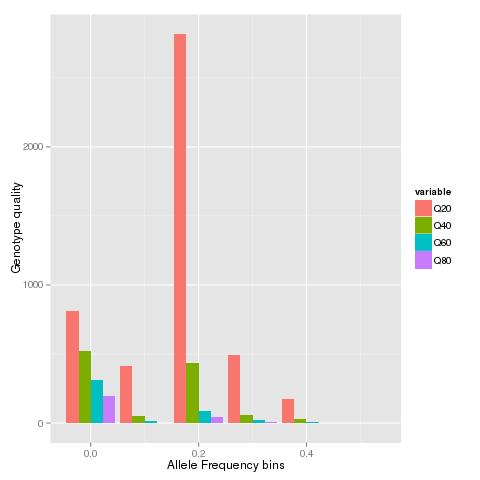
Effect of genotype qaulity on the site frequency spectrum

The below shell script takes vcf file as an argument in the for loop and calculates the allele frequencies using VCFTools. These allele frequencies are used to calculate a folded SFS by taking only the major alleles in the calculation.
 for VCF in vcf_file_name.vcf  
 do  
 mkdir "$VCF".dir  
 cd "$VCF".dir  
 cp ../data/"$VCF" .  
 for GQ in 20 40 60 80  
 do  
 #calculate allele frequencies with VCFtools  
 vcftools --vcf "$VCF" --freq --out test.af --minGQ "$GQ"  
 #Take vcf file and extract columns with allele frequency data, in this case the freq output we want columns five and six  
 cut -f5 test.af.frq > test_col1  
 cut -f6 test.af.frq > test_col2  
 cat test_col1 test_col2 > test_append  
 #removes blank line  
 sed -e '/^ *$/d' test_append > test_append2  
 #get rid of first line and first two characters (a/t/g/c:)  
 sed 1d test_append2 > test_append3  
 cat test_append3 | sed 's/^..//' > FILENAME_AFS  
 #To keep only values below 0.50  
 awk '$NF <0.50' FILENAME_AFS > FILENAME_AFS_50."$GQ"  
 echo "0" >> FILENAME_AFS_50."$GQ"  
 echo "0.1" >> FILENAME_AFS_50."$GQ"  
 echo "0.2" >> FILENAME_AFS_50."$GQ"  
 echo "0.3" >> FILENAME_AFS_50."$GQ"  
 echo "0.4" >> FILENAME_AFS_50."$GQ"  
 echo "0.5" >> FILENAME_AFS_50."$GQ"  
 rm FILENAME_AFS test.af.frq test.af.log test_append test_append2 test_append3 test_col1 test_col2  
 done  
 cp ../makebars.r .  
 Rscript makebars.r  
 cd ..  
 done  

The rscript makebars is used to read in each of the site frequency spectrum's at the different genotype quality thresholds and generate a barplot of the SFS.
 read.table(file="FILENAME_AFS_50.20",header=FALSE)->AF20  
 read.table(file="FILENAME_AFS_50.40",header=FALSE)->AF40  
 read.table(file="FILENAME_AFS_50.60",header=FALSE)->AF60  
 read.table(file="FILENAME_AFS_50.80",header=FALSE)->AF80  
 as.data.frame(table(round(AF20$V1,1)))->A20  
 as.data.frame(table(round(AF40$V1,1)))->A40  
 as.data.frame(table(round(AF60$V1,1)))->A60  
 as.data.frame(table(round(AF80$V1,1)))->A80  
 data.frame(Q20=A20$Freq,Q40=A40$Freq,Q60=A60$Freq,Q80=A80$Freq)->q  
 library(plyr)  
 library(ggplot2)  
 library(reshape)  
 Names=seq(0,0.5,0.1)  
 data=data.frame(cbind(q),Names)  
 data.m <- melt(data, id.vars='Names')  
 cbbPalette <- c("#000000", "#E69F00", "#56B4E9", "#009E73", "#F0E442", "#0072B2", "#D55E00", "#CC79A7")  
 jpeg("barplot.jpeg")  
 ggplot(data.m, aes(Names, value,fill = variable)) + geom_bar(stat="identity",position="dodge")+ xlab("Allele frequency bins") + ylab("Number of sites")  
 dev.off()  
When the VCF file from a published study is run through the script will generate a graph like below:

Wednesday, January 14, 2015

A tale of two Jared's

Both Jared Taylor and Jared Diamond, born to immigrant parents attended Ivy league colleges, wrote many books about humans. Specifically about the explanations for the differences between Eurasian people and other populations they conquered or displaced. These differences have shaped human history almost as much as the atom bomb or the motor car. Even today, study and discussion of such differences are very emotional issues.

While Taylor "eloquently" argues for a biological and genetic basis for these differences, Diamond has written books that provide an elaborate non-genetic explanation that invokes ecology to explain these differences. Diamond, argues that differences in the success of different populations could be attributed to prevalence of very different species of plants and animals in the continents inhabited by these populations. 

Although they share their first names, they are atleast as different as Paris and London. The demoralizing situation of the French peasantry is similar to situation faced by members of certain ethnic groups who happen to listen to Taylor speak. Availability of these videos on youtube makes it rather easy for any casual internet user to stumble upon it. 

The question is can one draw unflattering parallels to the explanation provided by Diamond? For instance it might not be possible to accept the explanation provided by Jared Diamond while still believing in some sort of concept of a benevolent god. Diamond provides arguably the best non-genetic explanation for the differences between human populations. Unfortunately, it fails to explain numerous inconsistencies. Lack of numerous more convincing explanations definitely needs to be remedied.