Showing posts with label assembly. Show all posts

Thursday, January 29, 2015

Mapping centromeres using Optical Map data

Optical mapping has become rather common for applications ranging from genome assembly improvement and validation to structural variation discovery. Validation of the rice genome using Optical map data also helped map centromeres and even span one centromere. However, in some cases centromeres have been found to correspond to regions that have poor mapping of optical maps, presumably due to the presence of tandem repeats that lack unique restriction sites. Without the availability of genetic linkage maps or other evidence, those working with NGS based draft assemblies have speculated that large gaps in the optical map correspond to centromeres or other repeats.

The Human genome has a higher quality as well as availability of various other resources such as genetic linkage maps, BAC's, FISH etc in addition to the availability of optical mapping data. Centromeres have been mapped in the human genome with various other methods and provides an ideal case to investigate the patterns(or lack thereof) shown by optical maps near centromeres. Optical map data for the human and mouse genome from published studies have been made available as bigBed files. This provides a unique resource to understand the behavior of optical maps near centromeres.

First we download the bigBed files for the human genome Hg38 and convert it to bed12 format. This can then be converted to bed format using the convert perl script

 wget ftp://ngs.sanger.ac.uk/production/grit/track_hub/hg38/om_align_GM10860.bigBed  
 wget ftp://ngs.sanger.ac.uk/production/grit/track_hub/hg38/om_align_GM15510.bigBed  
 wget ftp://ngs.sanger.ac.uk/production/grit/track_hub/hg38/om_align_GM18994.bigBed  
 for i in om_align_GM10860 om_align_GM15510 om_align_GM18994  
 do  
 bigBedToBed "$i".bigBed "$i".bed  
 perl convertBed.pl "$i".bed > "$i"_full.bed  
 done  

Perl script called covertBed.pl to convert bed12 to bed format.

 #!/usr/bin/perl  
 my $bed12file = $ARGV[0];  
 open(FILE1, $bed12file);  
      while($header1=<FILE1>) {  
      chomp $header1;  
      my @parts=split(/\t/,$header1);  
      my @parts2=split(/\,/,$parts[10]);  
      my @parts3=split(/\,/,$parts[11]);  
      my $arrSize = @parts2;  
           for($i=0;$i<$arrSize;$i++){  
           $start=$parts[1]+$parts3[$i];  
           $end=$start+$parts2[$i];  
           print "$parts[0]\t$start\t$end\t$parts2[$i]\n";  
           }  
      }  
 close FILE1;  
We next create 50Kb windows across the human genome to analyze the distribution of cut sites in the Optical map.
 mysql --user=genome --host=genome-mysql.cse.ucsc.edu -B -A -D hg38 -e 'select chrom,size from chromInfo' > chromhg38.genome  
 bedtools makewindows -g chromhg38.genome -w 50000|sort -k1,1 -k2,2n > 50kb.wins  
All 3 Optical maps are combined and the mean of the fragment lengths as well their counts are tabulated in 50Kb windows.
 cat *_full.bed|sort -k1,1 -k2,2n > full_all.bed  
 bedtools map -a 50kb.wins -b full_all.bed -c 4 -o mean -null NA > all.mean  
 bedtools map -a 50kb.wins -b full_all.bed -c 4 -o count -null NA > all.count  
Analysis of these numbers across each chromosome suggests that mean fragment size might be a better predictor of centromeres than the count. The position of the centromeres is obtained from the UCSC tables using below command:

 mysql --user=genome --host=genome-mysql.cse.ucsc.edu -B -A -D hg38 -e 'select chrom,chromStart,chromEnd from centromeres'|grep -v "chromStart" > centromeres.hg38.genome  
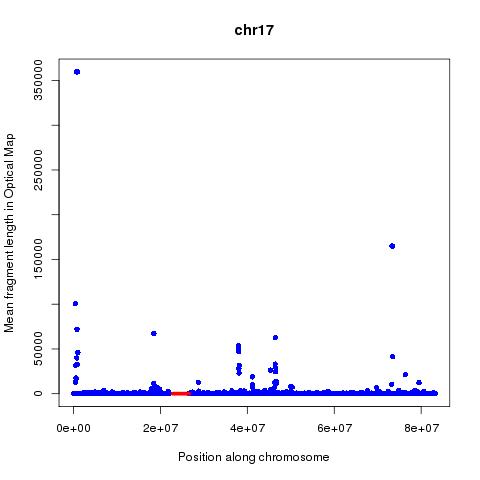
Running below R code will create graphical images showing the position of the centromeres by red lines and the mean fragment size by blue dots.
 for (chr in c("chr1","chr2","chr3","chr4","chr5","chr6","chr7","chr8","chr9","chr10","chr11","chr12","chr13","chr14","chr15","chr16","chr17","chr18","chr19","chr20","chr22","chrX"))  
 {  
 read.table(file="all.mean",header=F)->M  
 read.table(file="centromeres.hg38.genome",header=F)->C  
 interleave <- function(v1,v2)  
 {  
 ord1 <- 2*(1:length(v1))-1  
 ord2 <- 2*(1:length(v2))  
 c(v1,v2)[order(c(ord1,ord2))]  
 }  
 jpeg(paste(chr,"_OM.jpeg",sep=""))  
 plot(M$V2[M$V1==chr],M$V4[M$V1==chr],xlab="Position along chromosome",ylab="Mean fragment length in Optical Map",main=chr,col="blue",pch=16)  
 lines(interleave(C$V2[C$V1==chr],C$V3[C$V1==chr]),rep(0.2,length(interleave(C$V2[C$V1==chr],C$V3[C$V1==chr]))),col="red",lwd=5)  
 dev.off()  
 }  
Based on below figures, it can be hypothesized that on chr1, chr2, chr3(to certain extent), chr7, chr9, chr11(to certain extent),chr12,chr13, chr14,chr15 and chr20 the mean optical fragment size goes up near centromeres.


Based on the above analysis can one conclude that it is possible to map Centromeres using Optical mapping data? Far from it, the many false positives and lack of signal in many cases are worrying. The following questions are of importance:
 
  1. How does the quality of the genome assembly in the regions adjoining the centromere affect the ability to map centromeres?
  2. How does the enzyme used and repeat content and base composition of the centromere affect the precision of attempts aimed at mapping the centromere?

Monday, September 24, 2012

RNA-seq challenges and strategies

RNA-seq is being used by a diverse group of users for investigating very diverse problems. De novo assembly has been seen as easy to use and effective way to utilize the power of RNA-sequencing in non-model organisms. While genome assembly programs have been investigated by various reviews and others such as ASEMBLETHON and GAGE, de novo transcriptome assemblers have not been investigated in great detail. We looked at de novo transcriptome assemblies generated by Illumina assemblers from many perspectives. Apart from the obvious structural error characterization, other factors such as sequencing error, polymorphism (pi), paralogs to name a few. 

Using real data would be ideal to test programs, however, in this case it becomes difficult to distinguish artifacts from novel biology, so simulation is a good idea to perform some sort of validation and quantification of errors of various types.

The simulation paper on RNA-seq for the special issue on Next-gen sequencing is finally available online : Challenges and strategies in transcriptome assembly and differential gene expression quantification. A comprehensive in silico assessment of RNA-seq experiments.


Thursday, March 3, 2011

Break scaffolds into Mate pairs

Could not find any programs that can merge a set of scaffolds. Hence, decided to break the scaffolds into mate pairs and use those for scaffolding. Below is a simple perl script to break scaffolds into all possible mate pairs in a format suitable for SSPACE (a hierarchical scaffolder). It can easily be modified to work for BAMBUS or any other scaffolder or assembler.


#!/usr/bin/perl

#AUTHOR
# Nagarjun Vijay (c) 2011
# mate maker.pl - program to break scaffolds into mate pairs
#

#DATE
# 3rd March 2011
#

use strict;

my $scafile=$ARGV[0];

#reading the scaffold sequences
open SCAF, "<",$scafile or die $!;

#open contigs file
open CONTIG, ">>",$scafile . ".contigs.fa" or die $!;


#open contigs file
open LIB, ">>",$scafile . ".lib" or die $!;

my ($scaffoldcount,$seqst_temp,$contigcount,$notscaffoldcount,$z,$head,$i,$j,$libcount);
$scaffoldcount=0,$seqst_temp="",$contigcount=0,$notscaffoldcount=0,$libcount=0;
my $header = ;#reading the first header

while($z = ){
if($z=~ />/)
{
#split scaffold into contigs
if($seqst_temp=~ m/[N]+/){#is really a scaffold
$scaffoldcount++;
$contigcount +=SplitScaffold($seqst_temp);
}#end of scaffold check if
else{#not a scaffold - so not writing into breaker file
$head=">unbreak";
$notscaffoldcount++;
print CONTIG $head . "" . $notscaffoldcount ."\n";
print CONTIG "$seqst_temp\n";
}#end of scaffold check else

#next sequence
$seqst_temp="";
}
else
{
$z =~ s/[\n\t\f\r_0-9\s]//g;
$seqst_temp .= $z;
}
}#end of File while loop

if($seqst_temp=~ m/[N]+/){#is really a scaffold
$scaffoldcount++;
$contigcount +=SplitScaffold($seqst_temp);
}#end of scaffold check if
else{#not a scaffold - so not writing into breaker file
$head=">unbreak";
$notscaffoldcount++;
print CONTIG $head . "" . $notscaffoldcount ."\n";
print CONTIG "$seqst_temp\n";
}#end of scaffold check else
close SCAF;
close CONTIG;

#Split scaffolds, write contigs and breaker file
sub SplitScaffold{
my $seq = shift;
my ($head,$num,$contigs,$n);
$head=">breaker$scaffoldcount";
$num=1,$contigs=1;
my @values=split(/([N]+)/,$seq);
my $vallen= scalar (@values);
for($i=0;$i<$vallen;$i++) {
my $val=$values[$i];
if(($num % 2) == 0){
$n = length $val;
}
else{
print CONTIG $head . "" . $contigs ."\n";
print CONTIG "$val\n";
$contigs++;
my $matedist=(length $values[$i])+(length $values[$i+1])+(length $values[$i+2]);
for($j=$i+2;$j<$vallen;$j=$j+2){
print LIB "lib".$libcount." l".$libcount."s".$scaffoldcount."b".$i.".fasta l".$libcount."s".$scaffoldcount."b".$j.".fasta ".$matedist." 0.75 0\n";
$matedist=$matedist+(length $values[$j+1])+(length $values[$j+2]);
open READ1, ">>","l".$libcount."s".$scaffoldcount."b".$i.".fasta" or die $!;
open READ2, ">>","l".$libcount."s".$scaffoldcount."b".$j.".fasta" or die $!;
print READ1 ">l".$libcount."s".$scaffoldcount."b".$i."\n";
print READ1 $values[$i]."\n";
print READ2 ">l".$libcount."s".$scaffoldcount."b".$j."\n";
print READ2 reverseComplement($values[$j])."\n";
close READ1;
close READ2;
$libcount++;
}

}
$num++;
}

return $contigs;
}
#reverse complement a sequence
sub reverseComplement{
$_ = shift;
tr/ATGC/TACG/;
return (reverse());
}
#end of Breaker

Thursday, January 20, 2011

Minimus2 larger datasets with Nucmer

While Blat is much more faster than Nucmer, its results can be very different from the results from Nucmer. A version of Minimus2 which splits the data before feeding it to Nucmer and merging it back before processing further is able to give a result which is almost always identical to the results from Nucmer. The changes required to be done are given below:

NUCMER = nucmer
DELTAFILTER = delta-filter
SHOWCOORDS = show-coords
RUNNUCMER = perl runnucmer.pl
#------------------------------------------------------------------------------#

## Building AMOS bank & Dumping reads
10: rm -fr $(BANK)
11: $(BINDIR)/bank-transact -c -z -b $(BANK) -m $(TGT)
12: $(BINDIR)/dumpreads $(BANK) -M $(REFCOUNT) > $(REFSEQ)
13: $(BINDIR)/dumpreads $(BANK) -m $(REFCOUNT) > $(QRYSEQ)

## Getting overlaps
20: $(RUNNUCMER) $(OVERLAP) $(REFSEQ) $(QRYSEQ) $(PREFIX)
21: $(SHOWCOORDS) -H -c -l -o -r -I $(MINID) $(ALIGN) | $(BINDIR)/nucmerAnnotate | egrep 'BEGIN|END|CONTAIN|IDENTITY' > $(COORDS)
22: $(BINDIR)/nucmer2ovl -ignore $(MAXTRIM) -tab $(COORDS) | $(BINDIR)/sort2 > $(OVLTAB)


The code for runnucmer.pl is given below:

#!/usr/bin/perl

$allowedsize=100000000;

$overlap=$ARGV[0];
$mainref=$ARGV[1];
$mainqry=$ARGV[2];
$mainpre=$ARGV[3];
$reflen=0;
$refcount=1;

$qrylen=0;
$qrycount=1;

#open first ref file
open FILE1, ">>",$mainpre."ref".$refcount or die $!;

#reading the refrence sequences
open FILE2, "<",$mainref or die $!;


$seqst_temp="";
$header = ;#reading the first header

while($z = ){
if($z=~ />/)
{#next sequence
$reflen=$reflen+length $seqst_temp;
if($reflen < $allowedsize)
{
print FILE1 $header;
print FILE1 $seqst_temp;
print FILE1 "\n";
}
else
{
$refcount++;
$reflen=0;
close FILE1;
open FILE1, ">>",$mainpre."ref".$refcount or die $!;
print FILE1 $header;
print FILE1 $seqst_temp;
print FILE1 "\n";
}
$header=$z;
$seqst_temp="";
}
else
{
$z =~ s/[\n\t\f\r_0-9\s]//g;
$seqst_temp .= $z;
}
}#end of File while loop

if($reflen < $allowedsize)
{
print FILE1 $header;
print FILE1 $seqst_temp;
print FILE1 "\n";
}
else
{
$refcount++;
$reflen=0;
close FILE1;
open FILE1, ">>",$mainpre."ref".$refcount or die $!;
print FILE1 $header;
print FILE1 $seqst_temp;
print FILE1 "\n";
}
$header=$z;
$seqst_temp="";


close FILE1;
close FILE2;

#open first qry file
open FILE1, ">>",$mainpre."qry".$qrycount or die $!;

#reading the refrence sequences
open FILE2, "<",$mainqry or die $!;


$seqst_temp="";
$header = ;#reading the first header

while($z = ){
if($z=~ />/)
{#next sequence
$qrylen=$qrylen+length $seqst_temp;
if($qrylen < $allowedsize)
{
print FILE1 $header;
print FILE1 $seqst_temp;
print FILE1 "\n";
}
else
{
$qrycount++;
close FILE1;
$qrylen=0;
open FILE1, ">>",$mainpre."qry".$qrycount or die $!;
print FILE1 $header;
print FILE1 $seqst_temp;
print FILE1 "\n";
}
$header=$z;
$seqst_temp="";
}
else
{
$z =~ s/[\n\t\f\r_0-9\s]//g;
$seqst_temp .= $z;
}
}#end of File while loop

if($qrylen < $allowedsize)
{
print FILE1 $header;
print FILE1 $seqst_temp;
print FILE1 "\n";
}
else
{
$qrycount++;
close FILE1;
$qrylen=0;
open FILE1, ">>",$mainpre."qry".$qrycount or die $!;
print FILE1 $header;
print FILE1 $seqst_temp;
print FILE1 "\n";
}
$header=$z;
$seqst_temp="";

close FILE1;
close FILE2;

for($i=1;$i<=$qrycount;$i++){
for($j=1;$j<=$refcount;$j++){
$refseq=$mainpre."ref".$j;
$qryseq=$mainpre."qry".$i;
$prefix=$mainpre."nuc".$j."".$i;
system("/bubo/home/h7/nagarjun/glob/tools/MUMmer3.22/nucmer -maxmatch -c $overlap $refseq $qryseq -p $prefix");
}
}


#merging delta files
open FILE1, ">>",$mainpre.".delta" or die $!;
for($i=1;$i<=$qrycount;$i++){
for($j=1;$j<=$refcount;$j++){
open FILE2, "<",$mainpre."nuc".$j."".$i.".delta" or die $!;
if(($i==1)&&($j==1)){while($a=){print FILE1 $a;}}
else{$a=;$a=;while($a=){print FILE1 $a;}}
}
}

Tuesday, January 18, 2011

Blat instead of Nucmer in Minimus2

Minimus2 is a good utility to merge assemblies based on the AMOS architecture. However, it has a limitation on the size of the input datasets. This is due to the Nucmer program is its pipline. Apart from Nucmer other steps are able to handle much bigger chunks of data. So instead of using Nucmer i tried using Blat. Although this gave me assemblies, they were not always correct and complete.

May be someday somebody will use it.In the meantime i try to use Nucmer iteratively on smaller chunks and then merge the output before the next step. This is possible as Nucmer is run with the option -maxmatch in Minimus, making it independent of the other sequences in the dataset.

1)The changes to Minimu2.acf in amos/src/Pipeline/:

BINDIR = /usr/local/bin
NUCMER = /usr/local/nucmer
DELTAFILTER = /usr/local/delta-filter
SHOWCOORDS = /usr/local/show-coords
BLAT = blat
BTON = perl psltoNucmer.pl

#-----------------------------
-------------------------------------------------#

## Building AMOS bank & Dumping reads
10: rm -fr $(BANK)
11: $(BINDIR)/bank-transact -c -z -b $(BANK) -m $(TGT)
12: $(BINDIR)/dumpreads $(BANK) -M $(REFCOUNT) > $(REFSEQ)
13: $(BINDIR)/dumpreads $(BANK) -m $(REFCOUNT) > $(QRYSEQ)

## Getting overlaps
20: $(BLAT) $(REFSEQ) $(QRYSEQ) $(BOUT) -fastMap -noHead -minIdentity=98
21: $(BTON) $(BOUT) | $(BINDIR)/nucmerAnnotate | egrep 'BEGIN|END|CONTAIN|IDENTITY' > $(COORDS)
22: $(BINDIR)/nucmer2ovl -ignore $(MAXTRIM) -tab $(COORDS) | $(BINDIR)/sort2 > $(OVLTAB)


2) The code for psltoNucmer.pl is given below:

#!/usr/bin/perl

open FILE2, "<",$ARGV[0] or die $!;

while($z = ){
@values=split(/\t/,$z);
print $values[15]."\t".$values[16]."\t|\t".$values[11]."\t".$values[12]."\t|\t".abs($values[16]-$values[15])."\t".abs($values[12]-$values[11])."\t|\t".(sprintf "%.2f",(($values[0]+$values[2]+$values[3])*100)/abs($values[12]-$values[11]))."\t|\t".$values[14]."\t".$values[10]."\t|\t".(sprintf "%.2f",(abs($values[16]-$values[15])*100/$values[14]))."\t".(sprintf "%.2f",(abs($values[12]-$values[11])*100/$values[10]))."\t|\t".$values[13]."\t".$values[9]."\n";
}#end of File while loop

3) blat output format details can be found here : http://genome.ucsc.edu/goldenPath/help/blatSpec.html

Tuesday, October 19, 2010

Handling duplicate accession numbers created by flowsim with sfffile command

Having simulated loads of 454 data with Flowsim, i wanted to assemble everything. Unfortunately Flowsim gives one output .sff file for one input fasta file. In my case there were some 1,00,000 fasta sequences and hence 1,00,000 .sff files.

Newbler (assembler for 454 data) just crashed when asked to assemble the data in these many different files. It worked upto 500 .sff files though.

When all the files where given as input to sfffile to combine into a single file it gave a cryptic "segmentation fault" error. It seemed as though all the loads of data generated by Flowsim would be wasted. As a lost resort i wrote a script to combine the .sff files two at a time.

The script crashed after running for 100 files. The culprit was "Flowsim". It had generated sequences with the same accession number in the different runs. sfffile was failing with "Error: Duplicate accession chr1:56036789..56039961_1148- found. Unable to write SFF file.". After further investigation it became clear that duplciate accession numbers had occured rather frequently. Later versions of Flowsim may have fixed this issue (I used version 0.1).

Since, the data had already been generated it had to "handled". sfffile does not have a flag to ignore duplicate accession numbers. Hence, a simple perl script that checks if sfffile failed in the previous step take care of the duplicate accession numbers. Perl script below:

 #!/usr/bin/perl  
 my $startfile="combined1.sff";  
 for($count=2;$count<8000;$count++){  
 $pcount=$count-1;  
 print "sfffile -o combined".$count.".sff combined".$pcount.".sff myreads.fasta.".$count.".sff \n";  
 $pfilename="combined".$pcount.".sff";  
 if(-e $pfilename){  
 system("sfffile -o combined".$count.".sff combined".$pcount.".sff myreads.fasta.".$count.".sff");  
 $filename="combined".$count.".sff";  
 if(-e $filename){$startfile=$filename;}  
 }  
 else {system("sfffile -o combined".$count.".sff ".$startfile." myreads.fasta.".$count.".sff");}  
 }